
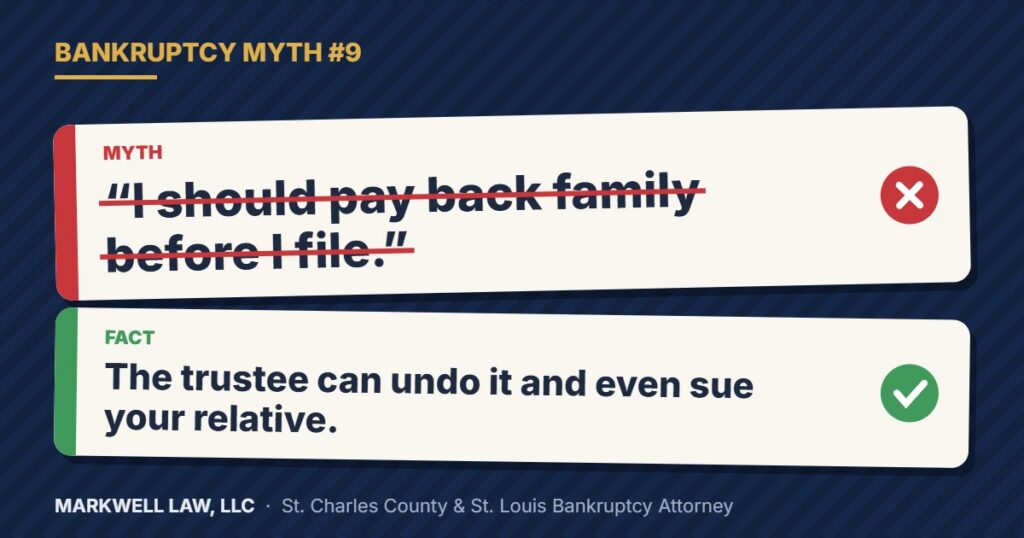
This myth is different from the others. Most bankruptcy myths just scare people away from filing. This one can actually wreck a case.
It usually comes from a good place. People feel guilty about the family member who loaned them money, so they want to pay that person back before they file. Or a friend tells them to “put the car in your brother’s name” so the trustee can’t get it. Both ideas can backfire badly.
Paying Back Family: The Preference Problem
The Bankruptcy Code is built on fairness to creditors. If you pay one creditor ahead of the others right before filing, the trustee can undo that payment. These are called “preferential transfers,” and they’re covered by 11 U.S.C. § 547.
For regular creditors, the trustee can look back 90 days. But for “insiders,” which includes relatives, the look-back period is a full year (§ 547(b)(4)(B), with “insider” defined in § 101(31)). So if you paid your mom back $5,000 in the year before filing, the trustee can demand that money from her.
That’s right. Your mother, who did you a favor, can get a letter from the trustee asking for the money back. And if she doesn’t pay, the trustee can sue her.
Or, as the conversation usually goes:
Debtor: “I paid my grandma, ’cause, well, she’s my grandma.”
Bank: “That’s not fair, and we don’t care if she is his grandma.”
Debtor: “But she’s my grandma!”
Trustee: “Great. Tell her to give that money to me.”
Moving Property: The Fraudulent Transfer Problem
Giving away property, or “selling” it to a relative for less than it’s worth, is even riskier. The trustee can undo transfers made within two years of filing under 11 U.S.C. § 548. In Missouri, the trustee can also use the state’s Uniform Fraudulent Transfer Act (RSMo 428.024) through 11 U.S.C. § 544(b), which can reach back four years.
And it can get worse than losing the property. If a transfer was made to hide assets from creditors within a year of filing, the court can deny your discharge altogether (11 U.S.C. § 727(a)(2)). Hiding assets in a bankruptcy case can even be a federal crime under 18 U.S.C. § 152. That’s a whole different kind of lawyer you don’t want to need.
A Typical Example
(This is an illustrative example, not a real client.)
Kevin lives in Lake Saint Louis. His dad loaned him $8,000 to cover rent when he was laid off. Kevin felt terrible about it, so when he got his $6,000 tax refund, he gave it straight to his father. Four months later, buried in credit card debt, he filed bankruptcy on his own.
The trustee found the payment on his bank statements and sent his father a demand letter for $6,000. Kevin’s dad, who was retired and on a fixed income, had already spent most of it on a new furnace. Everyone ended up worse off than if Kevin had simply talked to a lawyer first. With some planning, that refund could have been handled very differently.
What You Can Do Instead
None of this means you can never pay family back. It means you need to talk to a bankruptcy attorney before you move money or property around. Some options:
- Wait until after your bankruptcy is over, then pay your relative back voluntarily if you want to.
- Time your filing so that payments fall outside the look-back period.
- Use exempt assets, which the trustee can’t touch anyway, in ways that are legal and disclosed.
Keep paying normal living expenses, like rent, utilities, groceries, your car payment and your mortgage. Those aren’t the problem. Unusual payments to people you’re close to are.
The Bottom Line
Before filing, the most dangerous thing you can do is “help” the people you love by paying them first or parking property with them. Be honest, disclose everything, and get advice before you act. That keeps your family out of the trustee’s crosshairs.
Talk to Someone Who Actually Knows
The only opinion about your bankruptcy that really matters is one based on your actual numbers. Call Markwell Law, LLC at (636) 486-1093 or contact us online. We’ll sit down, look at your situation honestly, and tell you what your options really are.
Related Bankruptcy Myths
This is one post in my series on common bankruptcy myths. Read the rest to separate fact from fiction.