
Here’s a question I hear in almost every Chapter 13 consultation: “If my credit cards get wiped out at the end of the plan, why don’t my student loans?”
Fair question. Both are unsecured. Neither one has a car or a house attached to it. So why does one disappear while the other is still waiting for you at the finish line? Because when it comes to student loans in Chapter 13, you get the worst of both worlds.
Sidenote: If you haven’t seen Borrowed Future, watch it now! This should be required viewing for all high school seniors. Yes, student loans are evil.
Unsecured? Yes. Priority? No.
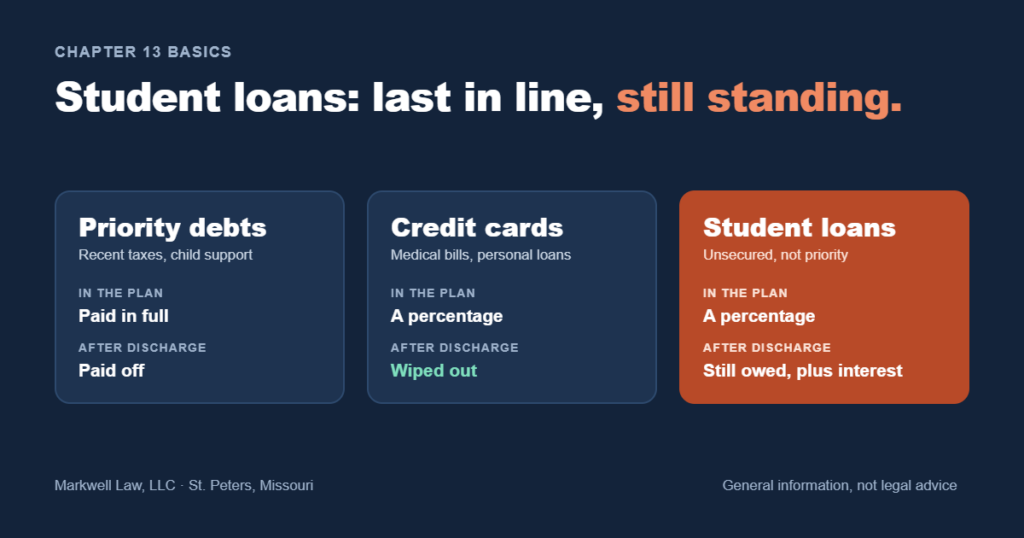
In bankruptcy, debts fall into three main buckets. Secured debts have collateral, like a mortgage or car loan. Priority debts are the ones Congress decided go to the front of the line, like recent income taxes and child support. A Chapter 13 plan has to pay priority debts in full. Everything else is general unsecured debt: credit cards, medical bills, personal loans. Those creditors split whatever money is left over, usually for a fraction of what they’re owed.
Student loans aren’t secured, and they aren’t on the priority list. They sit in the general unsecured pile, right next to your Visa bill. Last in line.
So Why Don’t They Get Discharged?
Because priority and discharge are two different questions. Priority decides where you stand in line during the plan. Discharge decides what’s still standing when the plan is over.
The Bankruptcy Code lists certain debts that survive a Chapter 13 discharge, and student loans made the list. It wasn’t always that way. Before 1990, a completed Chapter 13 could wipe out student loans. Congress closed that door, and it’s stayed closed.
There’s one way back through it: proving “undue hardship” in a separate lawsuit inside your bankruptcy. Here in Missouri, the Eighth Circuit Court of Appeals uses a “totality of the circumstances” test, which is more flexible than the test many other courts use. And for federal loans, the government now has a streamlined review process that has made these cases more winnable than they used to be. Still, it’s not automatic, and it’s not easy. (Private student loans are a different animal. Some don’t get the same protection, so have an attorney look at them.)
Meet Dana
Dana is hypothetical. She lives in St. Louis County, she’s behind on her mortgage, and she owes $38,000 in federal student loans plus $25,000 in credit cards and medical bills. She files Chapter 13 to save her house.
Her five-year plan pays $9,000 to her unsecured creditors, shared proportionally. The student loans get about $5,400, and the credit cards and medical bills get about $3,600. When Dana finishes, the remaining $21,400 on the cards and medical bills is gone forever.
The student loans are another story. Here, Dana is screwed! Her federal loans went into an automatic bankruptcy forbearance, but interest kept running the whole time. Dana could finish her plan owing more than $40,000, more than when she started. Is that a bad result? Not necessarily. She kept her house and wiped out $21,400. But she needs to see it coming.
Strategies for Handling Student Loans in the Plan
1. Pay them like everyone else. This is the most common approach, and the simplest. The student loans get their proportional share. The downside is what happened to Dana: the balance can grow.
2. Pay them in full or favor them. Sounds great, right? Pay the debt that won’t go away and let the others take less. The problem is that the other creditors are footing the bill. In Groves v. LaBarge (1994), the Eighth Circuit, the federal appeals court over Missouri, rejected a plan that paid student loans in full while other unsecured creditors got only 10 to 40 percent. Courts here watch closely for “unfair discrimination.” There are exceptions, like when a professional license depends on staying current, but you need a real reason.
3. Keep making regular payments. The Code lets a plan keep long-term debts current, and some debtors use it to keep paying student loans directly. Courts are split on whether that lets you favor student loans over everyone else, and it still has to pass the fairness test.
4. Protect your forgiveness clock. If you’re working toward income-driven repayment or Public Service Loan Forgiveness, the rules about whether Chapter 13 months count have changed several times in the last few years, and they depend on which repayment plan you’re in. Check this before you file. It can be worth thousands.
5. Challenge them. If your situation truly qualifies, the undue hardship lawsuit is the only path that actually wipes the debt out.
Who Really Comes Out Ahead?
Let’s be honest: most of these strategies are good for the lender.
When student loans are paid like everyone else, the lender collects a share of money that would otherwise go to the credit card companies, and it still keeps its claim for the rest, plus interest. When the plan pays them in full, the lender wins big and the other creditors lose, which is exactly why courts say no. When the plan pays them little or nothing, the lender just waits. The interest piles up, and it collects later.
Only two roads actually cost the lender money: an undue hardship discharge and loan forgiveness. That’s why the planning matters.
The Bottom Line
In most cases, Chapter 13 won’t erase your student loans. But it can stop the collection while your case is open, save your house and car, and wipe out the other debts fighting over your paycheck. You come out the other side in a position to deal with your student loans on your terms. (Here’s how the bankruptcy process works.)
If student loans are part of your financial picture, call Markwell Law, LLC in St. Peters for a free consultation. We’ll look at your loans, your plan, and your options before you file.
St. Peters, MO 63303
Phone: 636-486-1093
Fax: 636-634-3462