
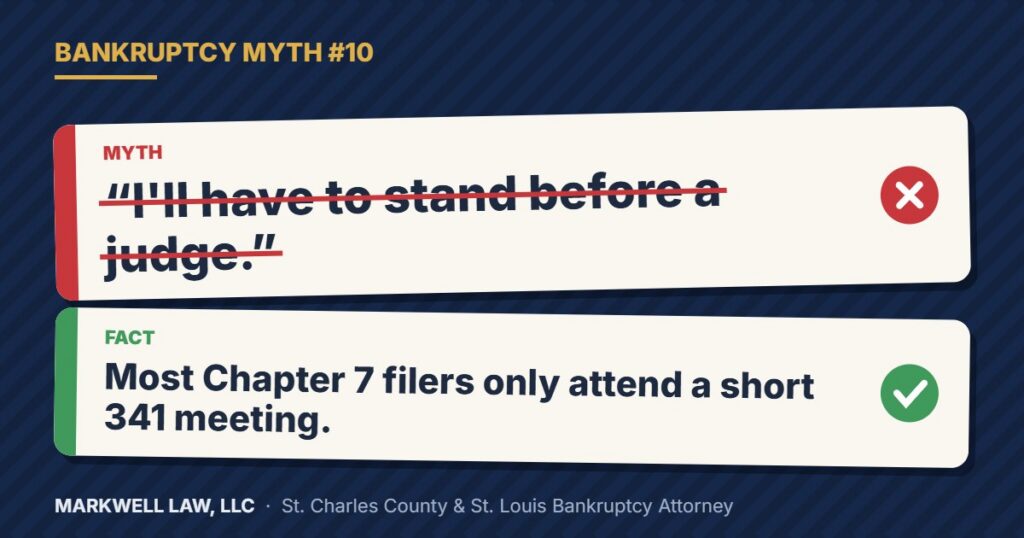
When people imagine filing bankruptcy, a lot of them picture a courtroom scene out of a TV drama. A stern judge peering over the bench, a packed gallery, and you standing up to explain to the whole world why you couldn’t pay your Visa bill.
That’s not what happens. In most Chapter 7 cases, you’ll never see a judge at all.
What You Actually Attend: The 341 Meeting
Every person who files bankruptcy attends a “meeting of creditors,” required by 11 U.S.C. § 341. Despite the name, it isn’t held in a courtroom, there’s no judge, and creditors almost never show up.
The meeting is run by the bankruptcy trustee assigned to your case. These days, it’s often held by video. The trustee will check your ID, put you under oath, and ask a short list of questions, like:
- Did you read and sign your bankruptcy papers?
- Is everything in them true and complete?
- Have you listed everything you own and everyone you owe?
- Have you transferred any property or paid back any relatives recently?
Your attorney is with you the whole time. For most people, the meeting lasts five to ten minutes. You can see the full list of usual questions in Questions Asked at the Meeting of Creditors and more about the process in 341 Creditors Meeting Information.
When Would a Judge Get Involved?
In a typical Chapter 7, the judge signs your discharge order without ever meeting you. A judge only gets involved when something is disputed, like:
- A creditor objects to a debt being discharged
- The trustee challenges something in your case
- A reaffirmation agreement on a car loan needs court approval (11 U.S.C. § 524(d))
Even then, your attorney is the one doing the talking. In Chapter 13 cases, there’s a confirmation hearing on your payment plan, but the attorneys handle it and you often don’t need to speak. If you’re curious where the court actually is, see Where Is the Bankruptcy Court?
A Typical Example
(This is an illustrative example, not a real client.)
Ron is a 67-year-old retiree from Ballwin. He’d co-signed a business loan for his son years ago, and when the business failed, the lender came after Ron. Between that and some medical bills, he was looking at $45,000 of debt on a Social Security and pension income.
What scared Ron most wasn’t losing anything. It was “standing in front of a judge.” He hadn’t been in a courtroom since a speeding ticket in 1985 and didn’t want to start now. His 341 meeting took six minutes on a video call from my conference room. The trustee asked him the standard questions, thanked him, and moved on. About two months later, his discharge arrived in the mail. Ron never saw a judge, and he told me it was easier than renewing his driver’s license.
The Other Thing You’ll Have to Do
There’s one more requirement people don’t expect: two short courses. One credit counseling course before you file, and one financial management course after (11 U.S.C. § 109(h) and § 727(a)(11)). They’re done online or by phone and take a couple of hours each. More on that in Required Bankruptcy Courses.
The Bottom Line
For most people in St. Charles County and St. Louis, the only “hearing” in their bankruptcy is a few minutes with the trustee, with their lawyer sitting right next to them. No gavel, no jury, no speeches.
Talk to Someone Who Actually Knows
The only opinion about your bankruptcy that really matters is one based on your actual numbers. Call Markwell Law, LLC at (636) 486-1093 or contact us online. We’ll sit down, look at your situation honestly, and tell you what your options really are.
Related Bankruptcy Myths
This is one post in my series on common bankruptcy myths. Read the rest to separate fact from fiction.