
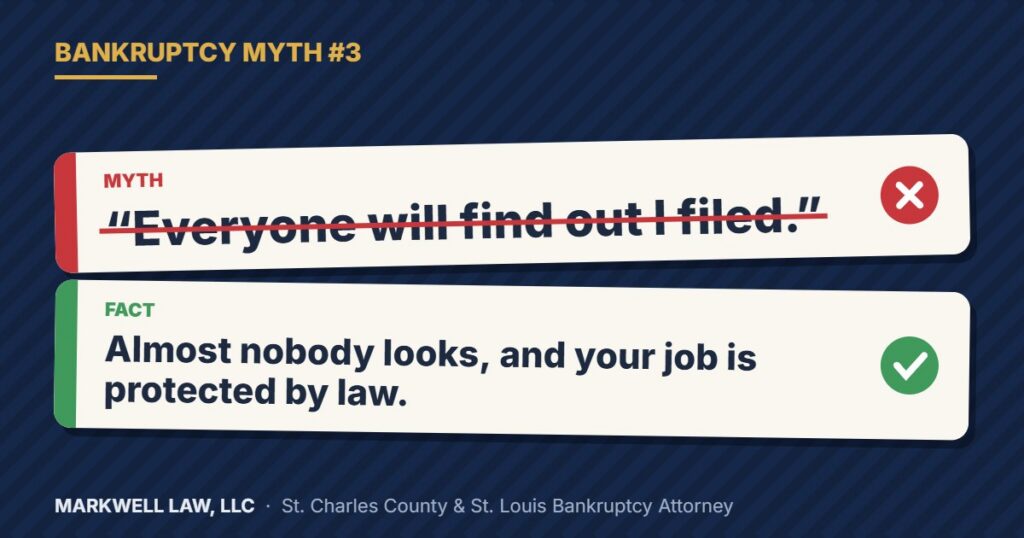
Right behind “Will I lose my house?” comes this one: “Who’s going to find out?” People worry about their boss, their coworkers, their in-laws, the folks at church, and that one neighbor who seems to know everybody’s business.
Here’s the truth. Bankruptcy is a public record. But being “public” and being “publicized” are not the same thing.
Who Actually Gets Notified
When you file, the court sends notice to the people who need to know: your creditors, the trustee and the U.S. Trustee’s office. That’s about it. Your employer isn’t notified unless they’re a creditor, or unless a wage garnishment needs to be stopped. Your neighbors aren’t notified. Your church definitely isn’t notified.
Can someone look it up? Technically, yes. Federal court records are available through a system called PACER. But it charges a fee, requires an account, and you’d have to know to look in the first place. Most people have no idea it exists. The St. Louis Post-Dispatch isn’t printing a list of names on the front page.
Can My Employer Fire Me for Filing?
No. Congress specifically addressed this. Under 11 U.S.C. § 525(b), a private employer cannot fire you, or discriminate against you in your employment, solely because you filed bankruptcy. Government employers, and government agencies that issue licenses, have even broader restrictions under § 525(a).
Is that protection perfect? No law is. Courts have disagreed about whether § 525(b) covers hiring decisions by private employers, so it’s strongest for people who already have the job. But the idea that filing gets you walked out of the building by security is a myth.
A Typical Example
(This is an illustrative example, not a real client.)
Jenna teaches middle school in Kirkwood. After her husband’s hours were cut and her mother’s medical bills landed on her, she was buried in about $40,000 of credit card and medical debt. Her biggest fear wasn’t losing anything. It was the idea that the principal, her coworkers and the parents would all “find out.”
She filed Chapter 7. Nobody at school was notified, because the school district wasn’t a creditor. As a public employee, she also had the protection of § 525(a). Her 341 meeting took about five minutes by video, her discharge came about three months later, and to this day the only people who know are her husband and her sister. Because she told them.
When People Might Find Out
To be fair, there are a few situations where someone could learn about your case:
- A wage garnishment. If your paycheck is being garnished, payroll will get notice to stop it. Honestly, most people are relieved by that.
- A co-signer. If a friend or relative co-signed a loan, they’ll want to know what’s going on.
- Future applications. Some applications, like mortgages or certain security clearances, ask whether you’ve ever filed.
You’re in Good Company
If you still feel like you’re the only one, you’re not. Over the last several years, hundreds of thousands of Americans have filed bankruptcy every year, including some very famous names. I’ve written about a few of them in You’re Not Alone: Famous People Who Have Gone Bankrupt and 20 Famous Bankruptcy Filings.
Debt collectors, on the other hand, are much more likely to embarrass you. They call your cell phone, sometimes call your work, and send letters to your house. Filing bankruptcy triggers the automatic stay, which stops all of that.
The Bottom Line
Bankruptcy is private in practice, even if it’s public on paper. The people who need to know will know. For most of my clients in St. Charles County and St. Louis, that’s where the list ends.
Talk to Someone Who Actually Knows
The only opinion about your bankruptcy that really matters is one based on your actual numbers. Call Markwell Law, LLC at (636) 486-1093 or contact us online. We’ll sit down, look at your situation honestly, and tell you what your options really are.
Related Bankruptcy Myths
This is one post in my series on common bankruptcy myths. Read the rest to separate fact from fiction.