
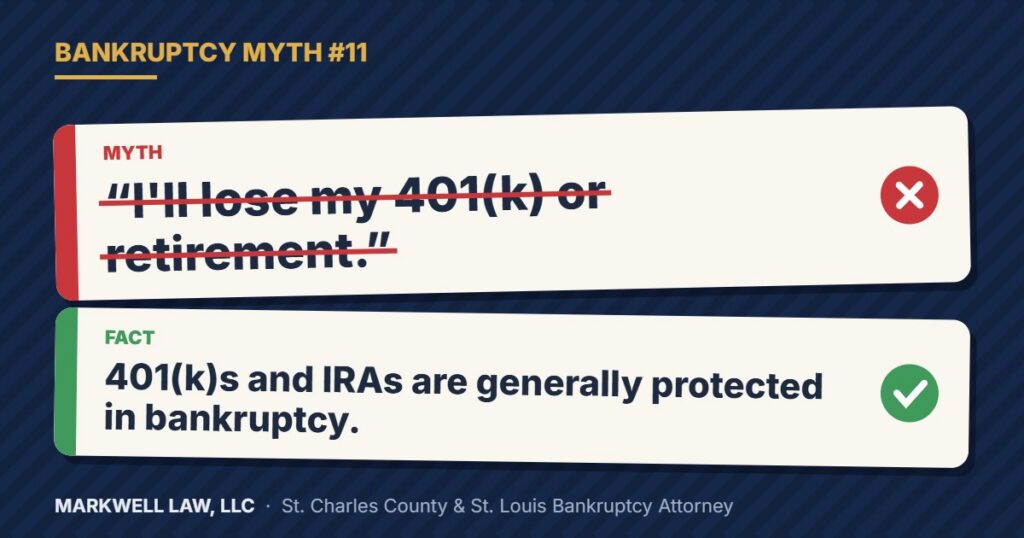
People tell me this all the time: “Before I came here, I cashed out my 401(k) to pay off the credit cards.” My heart sinks every time. In almost every case, that money would have been completely safe in bankruptcy.
So let’s clear this up: retirement accounts are generally protected when you file.
How the Law Protects Retirement Money
Retirement money is protected from several directions at once:
- 401(k)s, 403(b)s and pensions. Most employer plans are covered by ERISA, the federal law for retirement plans. In Patterson v. Shumate, 504 U.S. 753 (1992), the U.S. Supreme Court held that ERISA-qualified plans aren’t part of the bankruptcy estate at all. The trustee can’t touch them.
- IRAs and Roth IRAs. The Bankruptcy Code protects tax-exempt retirement funds (11 U.S.C. § 522(b)(3)(C)). Traditional and Roth IRAs are protected up to a cap that’s adjusted every three years and is now more than $1.7 million (11 U.S.C. § 522(n)). If you’re over that, congratulations, and we should talk about different things.
- Missouri law. Missouri protects retirement plans and IRAs under RSMo 513.430.1(10)(f). See Missouri Bankruptcy Exemptions: What You Get to Keep for the rest of Missouri’s exemptions.
Inherited IRAs are trickier. In Clark v. Rameker, 573 U.S. 122 (2014), the Supreme Court held that inherited IRAs aren’t “retirement funds” under the federal exemption. Whether yours is protected depends on the details and on state law. If you’ve inherited an IRA, tell your attorney.
Why Cashing Out Is Usually a Bad Idea
Pull money out of a 401(k) early to pay debt, and you’ll usually owe income taxes plus a 10% penalty. So $20,000 in your 401(k) might only put $13,000 or $14,000 toward your credit cards. If you end up filing bankruptcy anyway, that money is gone for good. You used it to pay debts that would have been wiped out for free.
You traded protected money to pay unprotected debt. That’s a bad deal, no matter how good it felt at the time.
A Typical Example
(This is an illustrative example, not a real client.)
Sharon is 58 and lives in Webster Groves. She worked 25 years for the same company and had about $140,000 in her 401(k). After her husband passed away, she was left with $38,000 in credit card debt and medical bills from his final illness. A coworker told her she’d “lose the 401(k) anyway” if she filed bankruptcy, so she should cash it out first. (Coworkers hand out a lot of free legal advice. It’s usually worth exactly what it costs.)
Luckily, Sharon called me first. Her 401(k) was fully protected. She filed Chapter 7, kept every dollar of her retirement and her home, and got rid of the $38,000. If she’d cashed out, she’d have lost a big chunk to taxes and penalties and still might not have paid everything off.
What About 401(k) Loans?
If you’ve borrowed from your 401(k), you can generally keep repaying that loan during and after bankruptcy (11 U.S.C. § 362(b)(19)). It’s your own money going back into your own account. Those repayments are treated a little differently in the Chapter 7 means test and in a Chapter 13 budget, so be sure to mention them.
Thinking About Retirement?
Protecting retirement savings is one of the best reasons to talk to a bankruptcy attorney sooner rather than later, especially for older folks. See Senior Citizens Filing Bankruptcy for more.
The Bottom Line
Your retirement account is one of the safest things you own in bankruptcy. Before you raid it to pay credit cards, talk to someone who can tell you whether you even need to.
Talk to Someone Who Actually Knows
The only opinion about your bankruptcy that really matters is one based on your actual numbers. Call Markwell Law, LLC at (636) 486-1093 or contact us online. We’ll sit down, look at your situation honestly, and tell you what your options really are.
Related Bankruptcy Myths
This is one post in my series on common bankruptcy myths. Read the rest to separate fact from fiction.