
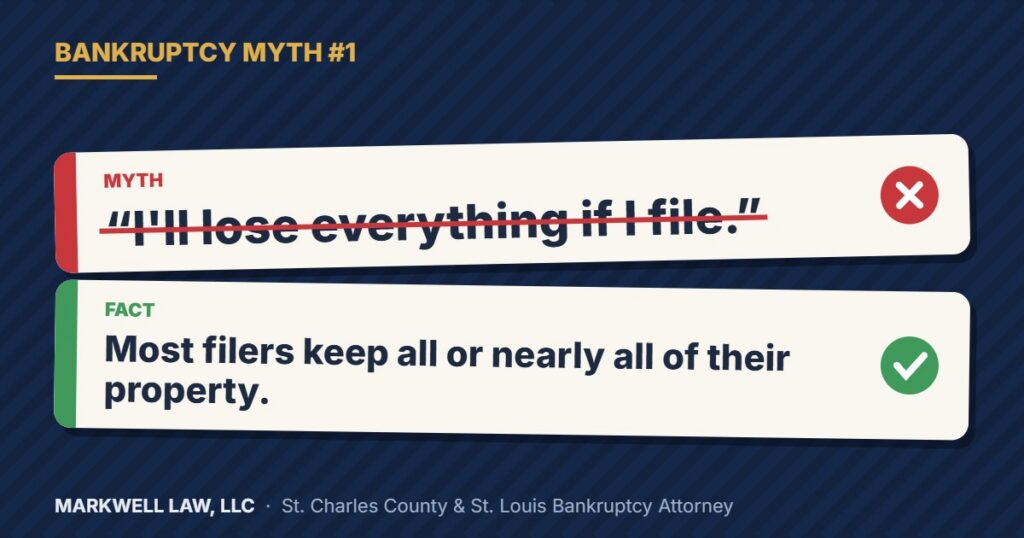
This is the big one. When someone sits down in my office for the first time, the very first question is usually some version of: “Am I going to lose my house?” The second is about the car. The third, more often than you’d think, is about the dog.
The short answer: almost everyone who files Chapter 7 bankruptcy in Missouri keeps all, or nearly all, of what they own. The dog stays, too.
Where the Myth Comes From
People picture bankruptcy as a guy in a suit showing up with a moving truck and hauling off the furniture. It doesn’t work that way. In a Chapter 7 case, a trustee is appointed to look at what you own. But the trustee can only take property that isn’t protected, and the law thar does the protecting does a lot of protecting..
Exemptions: The Rules That Protect Your Stuff
Exemptions are the laws that say which property is off-limits to creditors. Missouri has opted out of the federal exemption list, so Missouri filers use the Missouri exemptions (RSMo 513.427). The main ones are found in RSMo 513.430 and 513.475, and they cover the things most families actually own, the usual stuff so to speak:
- Your home (the homestead exemption, RSMo 513.475)
- Household goods, furniture, appliances and clothing
- Your car, up to a set amount of equity
- Tools of your trade
- Retirement accounts, which are generally protected in full
- A “wildcard” amount you can use on almost anything
And it’s getting better. Starting January 1, 2027, the homestead exemption jumps from $15,000 to $40,000, and the household goods exemption goes from $3,000 to $15,000. For the full list, see my guide, Missouri Bankruptcy Exemptions: What You Get to Keep. I also broke down the 2027 changes in Missouri Bankruptcy Exemptions Are Going Up on January 1, 2027.
It’s About Equity, Not Value
Here’s the part people miss. The exemptions protect your equity, not the full value of the item. If your car is worth $14,000 and you owe $12,000 on it, you only have $2,000 of equity to protect. Same with your house. A home worth $250,000 with a $235,000 mortgage has a lot less “exposure” than people fear.
If you want to keep a car or house with a loan on it, you generally keep paying the loan. Sometimes that means signing a reaffirmation agreement under 11 U.S.C. § 524(c). Sometimes it doesn’t. That’s a conversation for your attorney, not the internet.
Married? It May Get Even Better
Missouri recognizes “tenancy by the entirety” for married couples. If you and your spouse own property together that way, and only one of you files (or only one of you owes the debt), that property is generally protected from the individual debts of one spouse under 11 U.S.C. § 522(b)(3)(B). For a lot of married homeowners, that’s a big deal.
A Typical Example
(This is an illustrative example, not a real client.)
Mike and Dana live in O’Fallon. They own a house worth about $240,000 with $225,000 left on the mortgage, two cars with loans, ordinary furniture, a TV that’s bigger than it needs to be, and Mike’s 401(k). They have about $48,000 in credit card and medical debt after Dana’s surgery and a layoff.
They were convinced filing meant losing the house. In reality, the home equity, both cars, the household goods and the 401(k) all fit within their exemptions. They filed Chapter 7, kept paying the mortgage and car loans, and walked out of their case with the $48,000 wiped out and every piece of property still theirs. Including the TV.
When Property Can Be at Risk
I’m not going to tell you it never happens. If you have a lot of equity in a house, a paid-off second vehicle, a boat, cash in the bank, or a big tax refund coming, some of it might be exposed. That’s exactly why you sit down with a lawyer before filing. Good planning, and sometimes good timing, can make all the difference. And if protecting property in Chapter 7 isn’t possible, Chapter 13 lets you keep everything while you repay all, or a portion over three to five years.
You can read more about what the trustee looks at in Property of the Bankruptcy Estate.
The Bottom Line
Bankruptcy was designed to give honest people a fresh start, not to leave them sitting on the floor of an empty apartment. For most families in St. Charles County and St. Louis, filing means keeping the house, the car and the furniture while getting rid of the debt.
Talk to Someone Who Actually Knows
The only opinion about your bankruptcy that really matters is one based on your actual numbers. Call Markwell Law, LLC at (636) 486-1093 or contact us online. We’ll sit down, look at your situation honestly, and tell you what your options really are.
This is one post in my series on common bankruptcy myths. Read the rest to separate fact from fiction.