
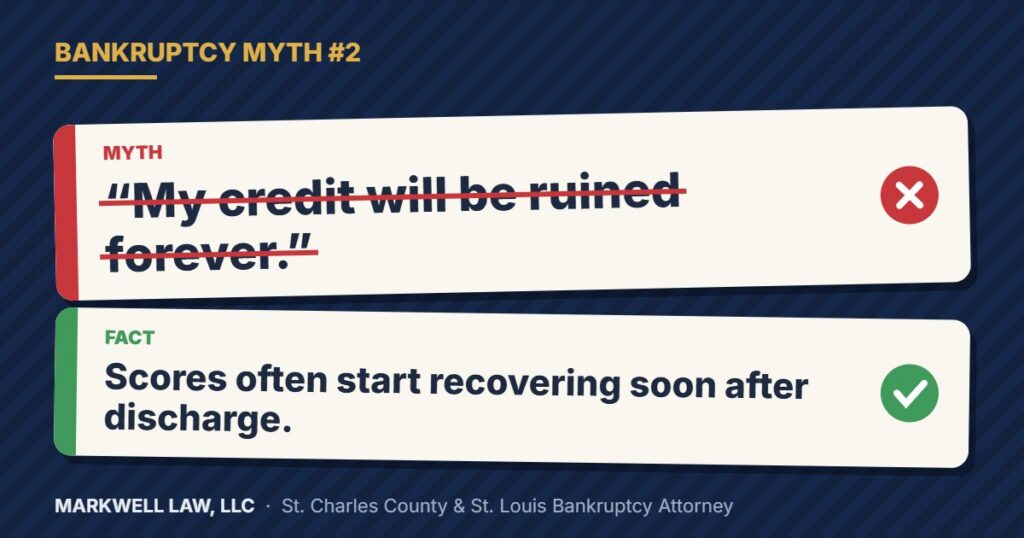
“If I file bankruptcy, my credit is ruined forever.” I hear it almost every week. And every week, I get to deliver some good news: it isn’t true.
Yes, bankruptcy shows up on your credit report. No, it doesn’t sentence you to a lifetime of cash-only living.
What the Law Actually Says
Under the Fair Credit Reporting Act, a bankruptcy can stay on your credit report for up to 10 years from the date you file (15 U.S.C. § 1681c(a)(1)). In practice, the credit bureaus typically remove a completed Chapter 13 after seven years.
But “on your report” and “ruining your credit” are two very different things. Your score is driven mostly by your recent payment history and how much debt you’re carrying. Bankruptcy fixes the second problem overnight, and gives you a clean slate to work on the first.
Be Honest: How’s Your Credit Right Now?
Most people who come to see me aren’t sitting on a 780 credit score. They’re behind on cards, they’ve got accounts in collections, and maybe a judgment or two. Their credit is already taking a beating, and it will keep taking one every month that the late payments pile up.
Bankruptcy stops the bleeding. Once your debts are discharged under 11 U.S.C. § 727, those accounts should report a zero balance, “discharged in bankruptcy.” Creditors are legally barred from trying to collect them (11 U.S.C. § 524(a)(2)). Your debt-to-income ratio, which lenders care about a lot, suddenly looks much healthier.
I wrote about the money behind all of this in Credit Score Fear Is Big Money. The people warning you about your score are often the same people profiting from your payments.
A Typical Example
(This is an illustrative example, not a real client.)
Carla works at a distribution center and lives in St. Peters. After a divorce, she was juggling $31,000 in credit card debt on one income. She’d been paying minimums for two years, missing a payment here and there, and her score had sunk into the low 500s. She held off on bankruptcy for a year because she was afraid it would “ruin” her credit.
She finally filed Chapter 7. Within a couple of months of her discharge, she had a secured credit card in the mail. A year later her score had climbed past where it was before she filed, because she had no late payments, no maxed-out balances and nothing left to fall behind on. Two years out, she financed a used car at a reasonable rate.
That’s not a miracle story. It’s a pretty common one.
How to Rebuild After Bankruptcy
Rebuilding takes some patience, but the steps are simple:
- Pull your credit reports after discharge and make sure every discharged debt shows a zero balance. Here’s how to get your credit report.
- Get one or two secured or starter cards, use them lightly and pay them in full every month.
- Pay every remaining bill on time. Rent, car loan, utilities, all of it.
- Don’t fall for “credit repair” companies charging you to do what you can do yourself for free.
For more, see Will Bankruptcy Affect My Credit Score? and Life After Bankruptcy.
The Bottom Line
Bankruptcy isn’t a credit death sentence. For a lot of people, it’s the fastest route to better credit, because it clears out the debt that was dragging the score down in the first place. Ten years on a report is not the same as ten years of bad credit.
Talk to Someone Who Actually Knows
The only opinion about your bankruptcy that really matters is one based on your actual numbers. Call Markwell Law, LLC at (636) 486-1093 or contact us online. We’ll sit down, look at your situation honestly, and tell you what your options really are.
Related Bankruptcy Myths
This is one post in my series on common bankruptcy myths. Read the rest to separate fact from fiction.