
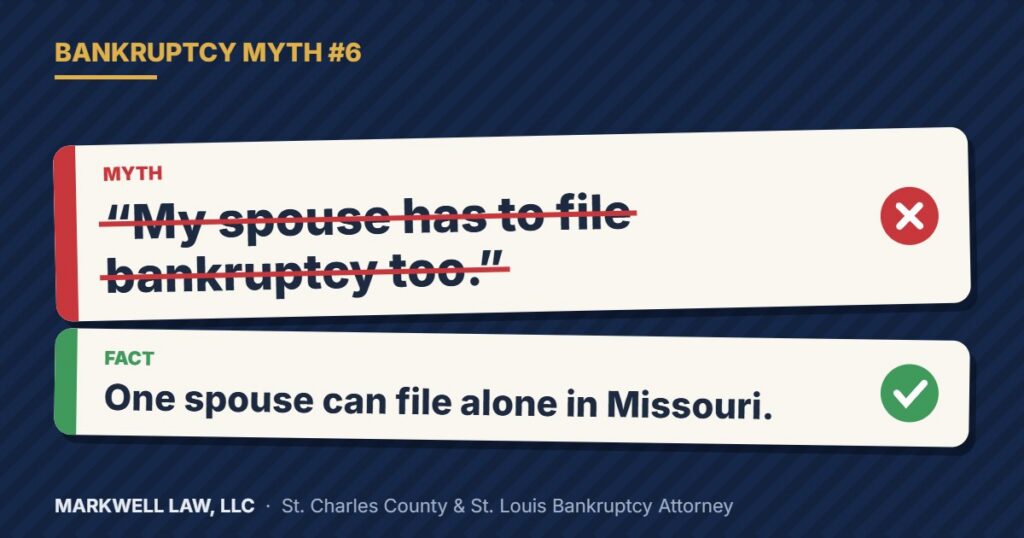
Married couples ask me this all the time, and usually one spouse is sitting there looking a little nervous: “If my husband files, do I have to file too? Will it wreck my credit?”
The short answer is no, you don’t have to file together. Whether you should is a different question, and the answer depends on whose name is on the debt.
You Can File Alone
The Bankruptcy Code allows married couples to file a joint case (11 U.S.C. § 302), but it doesn’t require it. Either spouse can file individually. When only one spouse files, only that spouse’s debts are discharged, and the non-filing spouse’s credit report generally isn’t touched.
The Joint Debt Catch
Here’s where it matters. If both of you signed for a debt, like a joint credit card, a co-signed car loan or a medical bill you both agreed to pay, bankruptcy only gets the filing spouse off the hook. The creditor can still go after the spouse who didn’t file for the full balance.
So the first thing we do is sort the debts into three piles: his, hers and ours. If most of the debt is in one spouse’s name only, filing alone often makes perfect sense. If most of it is joint, filing together usually does.
In a Chapter 13, the non-filing co-signer gets some extra protection while the plan is running, thanks to the codebtor stay in 11 U.S.C. § 1301.
Missouri’s Secret Weapon: Tenancy by the Entirety
In Missouri, married couples who own property together usually own it as “tenants by the entirety.” That form of ownership has a big benefit. Property held that way generally can’t be taken to pay a debt owed by only one spouse. In bankruptcy, that protection carries over under 11 U.S.C. § 522(b)(3)(B).
For a married couple where only one spouse has the debt, this can protect a home or joint bank account that would otherwise be exposed. It’s one of the more powerful tools in a Missouri bankruptcy, and a lot of people have never heard of it.
Your Spouse’s Income Still Counts
One thing that surprises people: even if your spouse doesn’t file, their income is usually included in the means test. You can then subtract the part of their income that goes to their own separate expenses. It’s paperwork, not a reason to panic, but it’s important to know going in.
A Typical Example
(This is an illustrative example, not a real client.)
Rob and Lisa have been married twelve years and live in Chesterfield. Rob ran a small landscaping business that didn’t survive a couple of bad seasons. He was left with about $70,000 in business credit cards and a line of credit, all in his name alone. Lisa had good credit, a steady job, and no part of those debts.
They both assumed they had to file together, and Lisa was dreading what it would do to her credit. Instead, Rob filed Chapter 7 by himself. Their house was owned as tenants by the entirety, so it was protected from his individual debts. Rob got his discharge, Lisa’s credit was never touched, and they kept the house.
When Filing Together Makes Sense
Filing jointly can be the better move when most of your debts are joint, when both of you are being sued or garnished, or when it simply makes sense to get the whole household a fresh start at once. A joint case also costs less than two separate cases.
The Bottom Line
Marriage doesn’t automatically drag your spouse into your bankruptcy. Sometimes it’s smart to file together. Sometimes it’s smarter to file alone. We’ll look at whose name is on what, and figure out which way protects your family best.
Talk to Someone Who Actually Knows
The only opinion about your bankruptcy that really matters is one based on your actual numbers. Call Markwell Law, LLC at (636) 486-1093 or contact us online. We’ll sit down, look at your situation honestly, and tell you what your options really are.
Related Bankruptcy Myths
- Myth #1: I’ll lose everything
- Myth #4: I make too much to file
- Myth #5: Bankruptcy wipes out every debt
This is one post in my series on common bankruptcy myths. Read the rest to separate fact from fiction.