
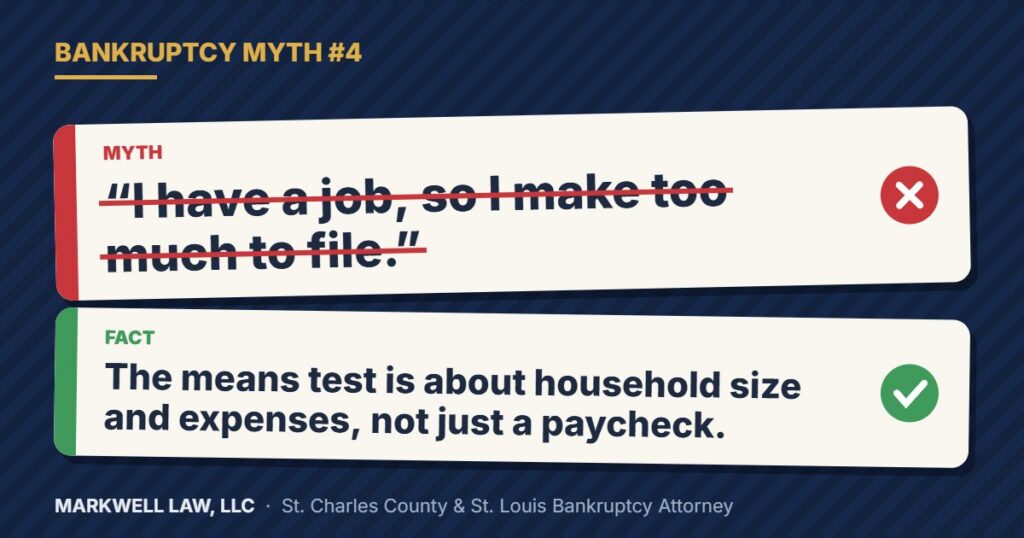
A lot of people assume bankruptcy is only for folks who are out of work. So they keep grinding, paying minimums on their credit cards with every paycheck, telling themselves, “I have a job, so I probably make too much to file.”
Maybe. But probably not. And even if you do, you’re not out of options.
The Means Test, in Plain English
Since 2005, people filing Chapter 7 have to pass what’s called the “means test” under 11 U.S.C. § 707(b). It’s a way of checking whether you truly can’t afford to repay your debts. It works in two steps.
Step one: compare your income to the Missouri median. We take your average gross household income over the six full months before you file (the Bankruptcy Code calls this “current monthly income,” defined in 11 U.S.C. § 101(10A)). Then we compare it to the median income for a Missouri household of your size. If you’re at or below the median, you pass. Done.
Step two: if you’re above the median, look at expenses. If your income is higher than the median, that’s not the end of the road. We then subtract allowed expenses, like your mortgage or rent, car payments, taxes, health insurance, child care and support payments. If what’s left over is small enough, you can still qualify for Chapter 7.
So the question is never just, “Do you have a job?” It’s, “How much does your household earn, how many people does it support, and what does it cost to live?”
I go into more detail in The Means Test and Do I Make Too Much to File Bankruptcy?
A Typical Example
(This is an illustrative example, not a real client.)
Travis works full time at a warehouse near Wentzville. With overtime, he makes about $58,000 a year. His wife works part time, and they have two kids. They owed about $35,000 on credit cards and a personal loan, mostly from a stretch when Travis was hurt and missed work.
Travis was sure they made too much. They’d never even asked a lawyer, because “we both work.” When we ran the numbers, their combined household income was below the Missouri median for a family of four. They passed the means test at step one and filed Chapter 7. Their overtime pay was finally going to the family instead of the credit card companies.
What If You Really Do Make Too Much?
Some people truly don’t pass the means test. That’s what Chapter 13 is for. In a Chapter 13, you keep your property and pay back a portion of your debts over three to five years through a court-approved plan (11 U.S.C. § 1322 and § 1325). Many people pay back pennies on the dollar for their unsecured debts, and the rest is discharged at the end.
Chapter 13 also does things Chapter 7 can’t, like helping you catch up on a mortgage you’re behind on and stopping a foreclosure.
Timing Can Matter, Too
Because the means test looks back six months, timing can change the answer. A big bonus, a lot of overtime, or a spouse’s job change in that window can push you over the median. Waiting a month or two, or filing sooner, can sometimes make all the difference. That’s one more reason to talk to a lawyer before you decide anything.
The Bottom Line
Plenty of working people, nurses, teachers, truck drivers, office managers and factory workers, file Chapter 7 every day. A paycheck doesn’t disqualify you. The only way to know for sure is to run the actual numbers.
Talk to Someone Who Actually Knows
The only opinion about your bankruptcy that really matters is one based on your actual numbers. Call Markwell Law, LLC at (636) 486-1093 or contact us online. We’ll sit down, look at your situation honestly, and tell you what your options really are.
Related Bankruptcy Myths
This is one post in my series on common bankruptcy myths. Read the rest to separate fact from fiction.