
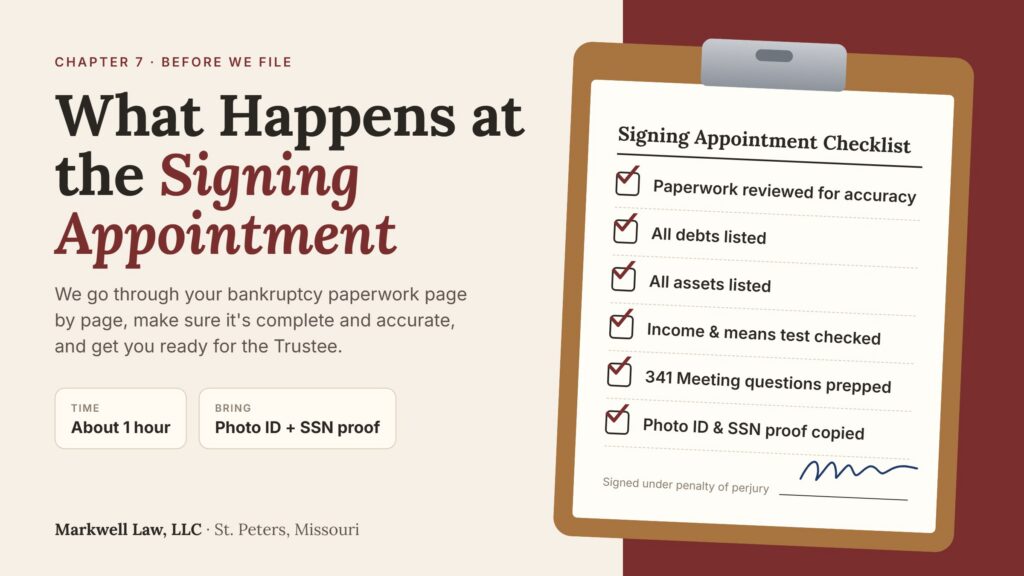
What Is the Signing Appointment?
You’ve dug the tax returns out of the closet, rounded up the paystubs, finished your credit counseling course, and filled out our questionnaire. Your bankruptcy paperwork is drafted. Now what?
Now comes what I call the signing appointment. This is a meeting between you and me where we sit down with your completed bankruptcy petition, schedules, and statements, go through them page by page, and then you sign them. It is the last stop before your case is filed with the bankruptcy court.
It is also one of the most important meetings in the entire bankruptcy process. Clients sometimes expect to sign their name a few times and head out the door. That’s not how I do it, and here’s why.
Reviewing the Paperwork for Accuracy
A Chapter 7 petition isn’t a one-page form. Between the petition, the schedules, the Statement of Financial Affairs, and the Means Test, you’re often looking at 50 pages or more. I prepare it from the information and documents you give me, but you are the one who knows your life best. If something is wrong, you’re the person most likely to catch it.
So we go through it together, line by line. We check the basics first: the spelling of your name, your address, the last four digits of your Social Security number, and the number of people in your household. Then we move on to the questions that get people in trouble when they’re answered too quickly, such as:
- Where have you lived in the last three years?
- Have you paid back a relative or friend in the last year?
- Have you sold, transferred, or given away any property in the last two years?
- Have you filed bankruptcy before?
- Are you involved in any lawsuits, either suing someone or being sued?
- Did you have any income from a business or a side job?
A typo seems harmless, and most of the time it is. But a wrong answer to one of those questions can turn a routine case into a problem. It’s a lot easier to fix a mistake on my desk than in front of the Trustee.
All Debts. All Assets. No Exceptions.
I say this to every client, and I’ll say it here: in bankruptcy, you list everything.
All of your debts. That includes the credit cards, the medical bills, the payday loans, and the old collection accounts you forgot about. It also includes the debts you plan to keep paying, like your car loan, and the money you owe your brother-in-law. I get it. You don’t want Uncle Bob getting a notice from the bankruptcy court. But the law doesn’t let you pick and choose which creditors get listed. You can still voluntarily pay back Uncle Bob after your case is over. You just can’t leave him off.
All of your assets. Your house, your cars, your household goods, your bank accounts, your retirement accounts, and your tax refunds all go on the schedules. So do the less obvious things: money someone owes you, a claim from a car accident, a pending inheritance, or the vacation fund sitting in an app on your phone.
Listing an asset doesn’t mean you’ll lose it. Missouri exemptions protect most of what the average person owns, and the signing appointment is where we confirm those exemptions are applied the way we planned. What gets you in trouble isn’t owning something. It’s not telling anyone about it.
Your Income and the Means Test
To qualify for Chapter 7, most people have to pass the means test. In plain English, the means test looks at your average household income over the six full calendar months before you file and compares it to the median income for a household of your size in Missouri. If you’re under the median, you generally qualify. If you’re over, we look at your allowed expenses to see whether you still pass.
The means test is a numbers game, so the numbers have to be right. At the signing appointment we review:
- Every paystub for the six-month look-back period
- Overtime, bonuses, and commissions, which can push an average up fast
- Side jobs, gig work, rental income, and child support or alimony received
- Regular contributions from anyone else in the household who helps pay the bills
- The number of people in your household
We also compare the means test to your Schedule I (income) and Schedule J (expenses) to make sure they tell the same story. The Trustee will check your paystubs against these forms. I would much rather you explain that one-time bonus to me than have the Trustee find it on their own.
You’re Signing Under Penalty of Perjury
This is the part I take the most seriously. When you sign your bankruptcy petition, you are declaring under penalty of perjury that everything in it is true and correct. That’s the same oath you’d take on the witness stand.
Bankruptcy fraud is a federal crime. Knowingly hiding assets or making a false statement can lead to fines and prison time, and at a minimum it can get your discharge denied. That means you’d walk away with all of your debts and none of the relief.
I’m not telling you this to scare you. The vast majority of my clients are honest people who fell behind because of a job loss, a medical problem, or a divorce. I’m telling you because your signature means something, and you should never sign anything you don’t understand. So ask questions. There’s no such thing as a dumb question at the signing appointment. A dumb question in my office is a lot cheaper than a hard question from the Trustee.
Getting Ready for the 341 Meeting of Creditors
About a month or so after we file, you’ll attend your 341 Meeting of Creditors. Despite the name, creditors rarely show up. The person asking the questions is the Chapter 7 Trustee, whose job is to review your case and look for assets that could be sold to pay creditors. Most 341 meetings in our district are now held by Zoom.
The signing appointment is your first round of preparation for that meeting. While we review your paperwork, I’m reading it the way a Trustee will. I’m looking for anything that might raise an eyebrow, such as:
- Tax refunds you’re expecting, or a large refund you already received and spent
- Equity in a house or a vehicle
- Payments to family members or friends in the past year
- Large purchases, cash advances, or new credit card charges right before filing
- Property you sold or transferred, including in a divorce
- A small business or side gig, even if it made very little money
- A possible inheritance, insurance payout, or lawsuit
If something in your case is likely to come up, we talk about it now. I’ll explain why the Trustee cares, how we’ve handled it in your paperwork, and what you can expect to be asked. I’ll also walk you through the standard questions every Trustee asks, so nothing on that Zoom call catches you off guard. Most 341 meetings last only a few minutes. A little preparation keeps it that way.
What to Bring
If you haven’t already given them to us, bring these two items to your signing appointment:
- A valid photo ID, such as your driver’s license, state ID card, or passport.
- Proof of your full Social Security number, such as your Social Security card, a W-2, or a statement from the Social Security Administration. A document showing only the last four digits won’t work.
The Trustee is required to verify your identity and Social Security number at the 341 meeting. If you can’t show them, the meeting gets rescheduled, your case gets dragged out, and you may end up paying additional attorney fees for the second meeting. Getting copies in our file now heads that off.
It also helps to bring your most recent paystubs, a current bank statement, and any new letters or lawsuit papers from creditors that showed up since you filled out the questionnaire. Things change, and the paperwork should reflect where you are on the day we file.
How Long Does It Take?
Plan on about an hour. Some appointments go faster, and some cases with a business, real estate, or a complicated income history take a little longer. Either way, this isn’t a meeting to squeeze in over your lunch break.
When we’re done, you’ll understand what’s in your petition, you’ll know what the Trustee is likely to ask, and you’ll have signed paperwork you can stand behind. From there, I file your case with the court, and the automatic stay goes into effect. That’s when the collection calls, garnishments, and lawsuits have to stop.
Bankruptcy is a fresh start, but it’s built on full and honest disclosure. The signing appointment is where we make sure yours is done right the first time.
Ready to talk about whether Chapter 7 is right for you? Contact Markwell Law, LLC in St. Peters to schedule a consultation. We help people throughout St. Charles County and the St. Louis area get out from under debt and back on their feet.