
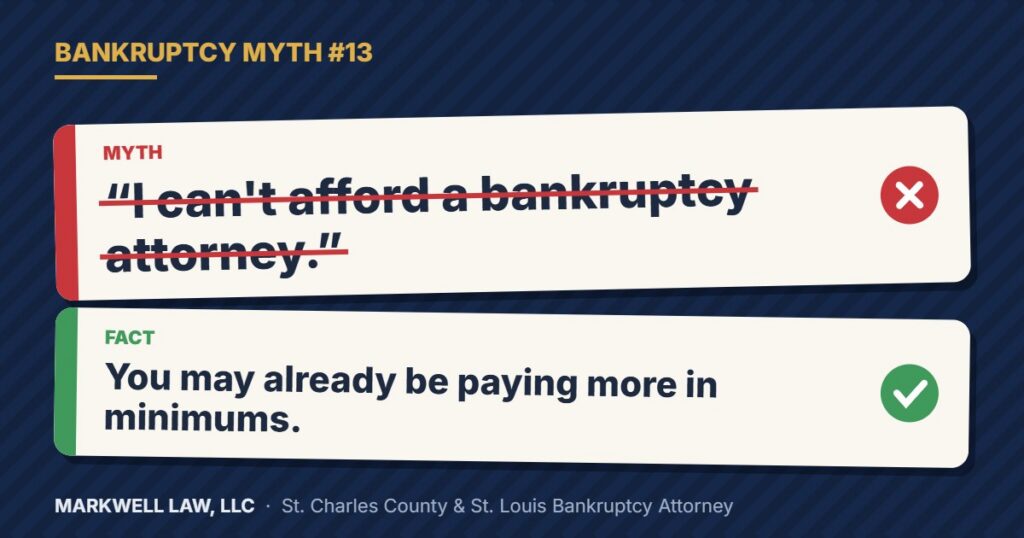
Here’s the irony of this myth. The people who most need a bankruptcy attorney are, by definition, the people who are short on money. So they figure they can’t afford one, and they keep sending payments to their creditors instead.
Let’s look at what you’re actually spending now, and what bankruptcy really costs.
Do the Math on What You’re Paying Now
Grab your credit card statements and add up the minimum payments. For many of my clients, it’s $400, $600, even $900 a month. Now look at how much of that is interest. Often it’s most of it. That’s money going out the door every month without making much of a dent.
Compare that to a one-time attorney fee and a court filing fee. For many people, a few months of minimum payments would cover the whole cost of a Chapter 7 bankruptcy, and when it’s done, the debt is gone. You can see a breakdown of what goes into the cost in What Does It Cost to File Bankruptcy? and Understanding Legal Fees.
Ways to Make It Affordable
There are more options than people realize:
- Stop paying the cards. Once you’ve decided to file, many people redirect what they were paying their creditors toward their attorney fee. Your attorney can tell you whether that makes sense in your case.
- Pay the court fee in installments. Federal Rule of Bankruptcy Procedure 1006(b) lets you pay the filing fee in installments.
- Ask for a fee waiver. If your household income is below 150% of the federal poverty guidelines, the court can waive the Chapter 7 filing fee entirely under 28 U.S.C. § 1930(f).
- File Chapter 13. In a Chapter 13, most of the attorney fee is usually paid through your plan over time (11 U.S.C. § 1326), so very little is due up front.
- Check your benefits. Some employers offer prepaid legal plans that cover bankruptcy. Markwell Law works with the MetLife Legal Plan.
What About Doing It Yourself?
You can file without an attorney. It’s legal. But bankruptcy has a lot of traps, like exemptions, the means test, preferences and filing deadlines, and mistakes can cost you property, your discharge, or both. I wrote about that honestly in Represent Yourself in Bankruptcy. Saving a few hundred dollars isn’t worth losing a car or a tax refund.
A Typical Example
(This is an illustrative example, not a real client.)
Steve drives a delivery route and lives in Maryland Heights. He had $42,000 in credit card debt spread over seven cards, and he was paying about $850 a month in minimums. After three years of that, he’d paid more than $30,000, and his balances were almost exactly where they started. He kept putting off calling a lawyer because he “couldn’t afford it.”
When he finally came in, the total cost of his Chapter 7 was less than three months of what he’d been paying the credit card companies. He filed, got his discharge, and that $850 a month started going into his own savings account instead of someone else’s.
The Bottom Line
The most expensive bankruptcy is often the one you put off. Every month you wait is another month of payments that buy you nothing. A consultation will tell you exactly what filing would cost in your situation, and you might be surprised.
Talk to Someone Who Actually Knows
The only opinion about your bankruptcy that really matters is one based on your actual numbers. Call Markwell Law, LLC at (636) 486-1093 or contact us online. We’ll sit down, look at your situation honestly, and tell you what your options really are.
Related Bankruptcy Myths
- Myth #4: I make too much to file
- Myth #5: Bankruptcy wipes out every debt
- Myth #10: I’ll have to face a judge
This is one post in my series on common bankruptcy myths. Read the rest to separate fact from fiction.