
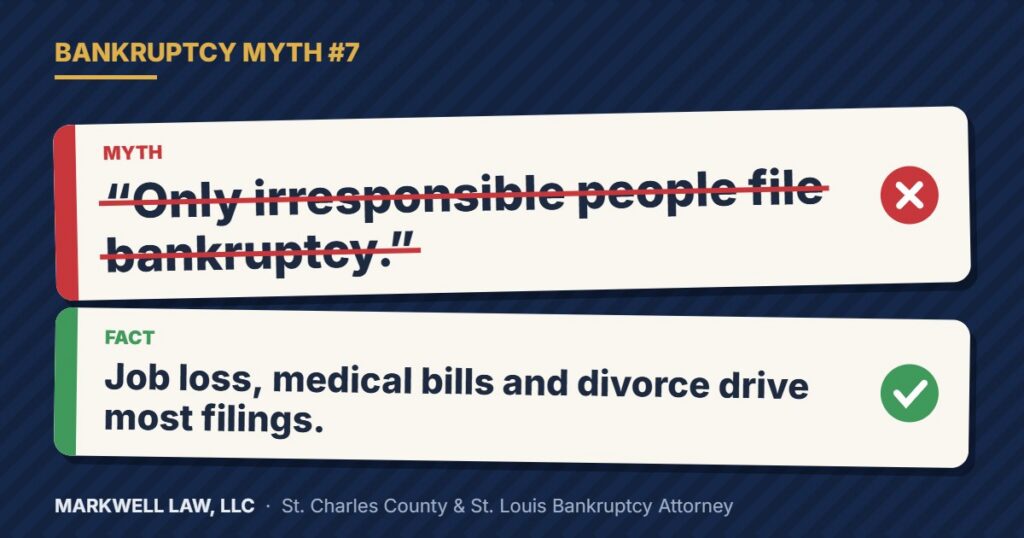
Of all the myths in this series, this is the one that keeps the most good people from getting help. It isn’t a myth about the law. It’s a myth about them: “Only deadbeats file bankruptcy.” “I made my bed, I have to lie in it.” “If I file, I’m a failure.”
I’ve been doing this a long time, and I can tell you who walks through my door. It isn’t deadbeats.
Who Actually Files
The people I represent are nurses, mechanics, teachers, retirees, small business owners and veterans. The reasons they’re in trouble are almost always the same handful of things:
- Job loss or a cut in hours
- Medical bills, even with insurance
- Divorce, which can turn one household’s bills into two
- A business that didn’t make it
- Caring for a sick parent or child
Most of them did what they were told to do. They used credit cards to bridge the gap, figuring things would turn around. Then the interest rate climbed, the minimums climbed, and the gap turned into a canyon. I wrote about why that’s so easy to fall into in Why Is It So Damn Hard to Resist Credit Cards.
What the Law Says About Who Bankruptcy Is For
Bankruptcy isn’t a loophole. It’s in the Constitution. Article I, Section 8 gives Congress the power to make “uniform Laws on the subject of Bankruptcies,” and the founders put it there on purpose.
The U.S. Supreme Court described the purpose of bankruptcy back in 1934, in Local Loan Co. v. Hunt, 292 U.S. 234. The Court said the law gives the “honest but unfortunate debtor” a new opportunity in life, free from the pressure of old debt. That’s the whole point. Bankruptcy was built for people who hit hard times honestly, and it has been for nearly a century.
If you like history, take a look at A History of Bankruptcy.
A Typical Example
(This is an illustrative example, not a real client.)
Denise has been a nurse for 22 years and lives in Hazelwood. In one year, she went through a divorce, then needed back surgery that kept her out of work for four months. Her short-term disability paid a fraction of her salary. She put the mortgage, groceries and copays on credit cards to stay afloat, and came out the other side with $52,000 in debt and a payment schedule that would take decades.
She sat in my office and apologized. More than once. She said she was “embarrassed to be one of those people.” There was nothing irresponsible about anything she did. She filed Chapter 7, kept her house and car, and went back to work without the weight of debt she was never going to be able to pay.
Lenders Know the Score
Here’s something worth remembering. Credit card companies know that some percentage of their customers will file bankruptcy. They build that risk into the interest rates and fees they charge everybody. It’s a business calculation for them. It should be a business calculation for you, too, not a moral one.
The Bottom Line
Filing bankruptcy doesn’t make you irresponsible. Sometimes it’s the most responsible thing you can do for your family. It takes courage to look at the numbers honestly and use the law the way it was designed. That’s the fresh start Congress intended.
Talk to Someone Who Actually Knows
The only opinion about your bankruptcy that really matters is one based on your actual numbers. Call Markwell Law, LLC at (636) 486-1093 or contact us online. We’ll sit down, look at your situation honestly, and tell you what your options really are.
Related Bankruptcy Myths
This is one post in my series on common bankruptcy myths. Read the rest to separate fact from fiction.