
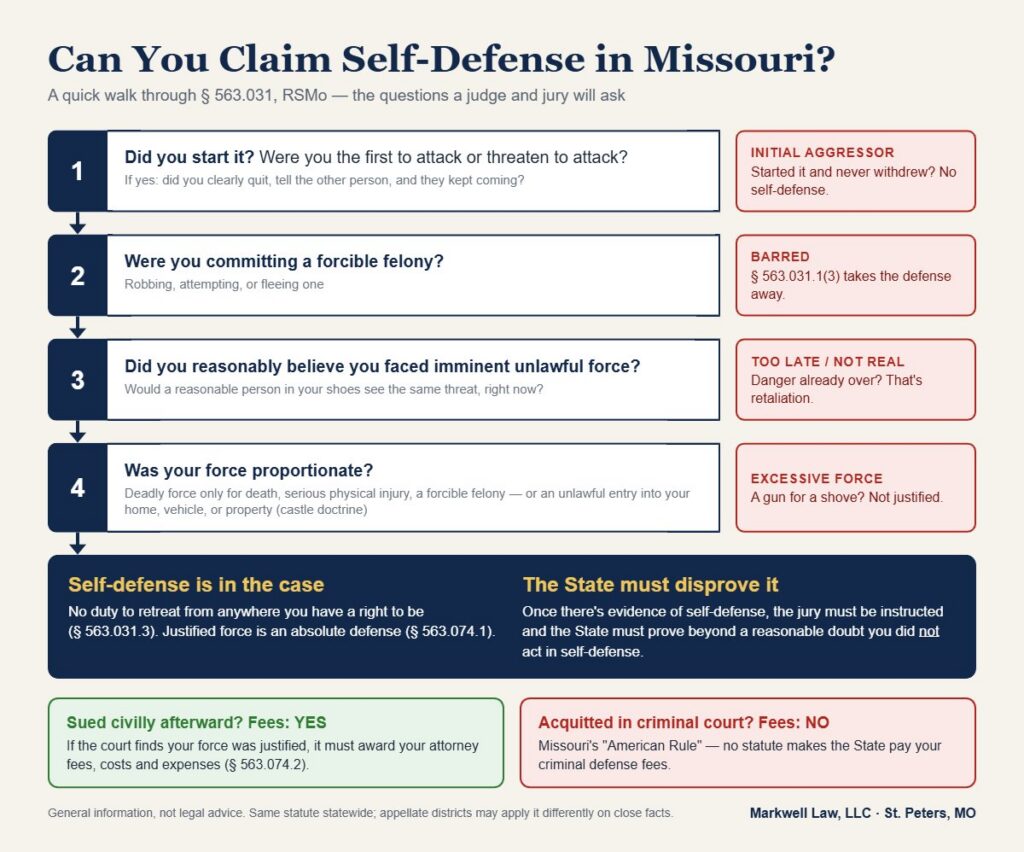
“It was self-defense.” I hear that a lot from people charged with assault. Sometimes it’s true. Sometimes it’s true-ish. And sometimes it’s what you say after the other guy ends up with the bigger knot on his head.
Missouri law gives you a real, powerful right to defend yourself. But self-defense isn’t a magic password that makes a charge disappear. It has rules, and if your facts don’t fit them, the defense goes nowhere. Here’s how it works.
What Is Self-Defense Under Missouri Law?
Self-defense in Missouri lives in Section 563.031, RSMo. In plain English, you may use physical force on another person when, and only to the extent, you reasonably believe it’s necessary to protect yourself (or someone else) from what you reasonably believe is the use or imminent use of unlawful force.
Notice the word “reasonably” shows up twice. It isn’t enough that you were scared. A reasonable person in your shoes has to have seen the same threat and believed the same response was necessary.
Deadly force has a higher bar. Under Section 563.031.2, you can only use deadly force if you reasonably believe it’s necessary to protect against death, serious physical injury, or a forcible felony (think robbery, rape, or kidnapping), or if someone unlawfully enters (or tries to enter) your home, residence, or vehicle while you’re lawfully in it, or private property you own or lease. That last part is Missouri’s version of the “castle doctrine.”
And Missouri is a “stand your ground” state. Under Section 563.031.3, you have no duty to retreat from your home or vehicle, from property you own or lease, or from any place you have a right to be.
When force is justified, Section 563.074.1 makes it an absolute defense to both criminal prosecution and civil liability.
The “Initial Aggressor” Rule (Primary Aggressor)
Here’s the catch most people miss: if you started the fight, you generally can’t claim self-defense.
Section 563.031.1(1) takes the defense away from the “initial aggressor.” Missouri’s approved jury instruction (MAI-CR 4th 406.06) defines that as the person who first attacks or threatens to attack. So you don’t have to throw the first punch to be the aggressor. Walking up to someone with your fists balled and saying “let’s go” can do it.
There’s a way back, though. An initial aggressor regains the right to self-defense if he withdraws from the fight, clearly communicates that he’s done, and the other person keeps coming anyway. Quietly backing up isn’t enough. The other person has to know you’ve quit.
What about “primary aggressor”? That’s a different term from a different statute, and people mix them up all the time. In domestic violence calls, Section 455.085 tells police to identify and arrest the “primary physical aggressor,” which the statute defines as the most significant aggressor, not necessarily the first. Officers weigh things like the comparative injuries, any history of domestic violence, and the need to protect victims.
Why does that matter? Because the officer’s “primary aggressor” call decides who goes to jail that night, but it doesn’t decide who wins at trial. At trial, the question is who was the initial aggressor. A person the police labeled the primary aggressor can still have a valid self-defense claim, and the reverse is true, too.
What You Need to Raise the Defense – Make it Happen!

Self-defense isn’t automatic. Under Section 563.031.5, the defendant has the burden of “injecting” the issue, meaning there has to be some evidence of self-defense in the record.
That bar isn’t very high. The Missouri Supreme Court says “substantial evidence” here just means evidence that puts the matter in issue, and it can come from the defendant’s own testimony alone. State v. Bruner, 541 S.W.3d 529 (Mo. banc 2018); State v. Westfall, 75 S.W.3d 278 (Mo. banc 2002). The court looks at that evidence in the light most favorable to the defendant.
Once the issue is injected, things flip. The judge must instruct the jury on self-defense, and the State must prove beyond a reasonable doubt that you did not act in self-defense. State v. Smith, 456 S.W.3d 849 (Mo. banc 2015); MAI-CR 4th 406.06. You don’t have to prove you were defending yourself. The prosecutor has to prove you weren’t.
To get there, the evidence generally has to show:
- You reasonably believed you faced imminent unlawful force;
- The force you used was reasonably necessary and proportionate to that threat;
- You weren’t the initial aggressor (or you withdrew); and
- For deadly force, you faced death, serious physical injury, or a forcible felony (or the castle doctrine applies).
Two warnings. First, thin facts can sink you. In Bruner, a divided Supreme Court held the trial judge properly refused the instruction because the evidence didn’t show the defendant reasonably believed deadly force was necessary. Second, ask for the instruction. In State v. Burkett, No. SC101071 (Mo. banc Dec. 29, 2025), the defendant never requested a self-defense instruction, and the Supreme Court refused to rescue him on appeal. And if your facts support the castle doctrine, ask for that instruction separately. In State v. Straughter, 643 S.W.3d 317 (Mo. banc 2022), the Court held it was error to refuse a castle-doctrine instruction where the victim used force against the defendant while she sat in her car.
When It Works, and When It Doesn’t
A few examples (all hypothetical):
It works:
- The bar fight. A stranger comes at Dave with a beer bottle. Dave punches him first. Dave didn’t start it, the threat was imminent, and a punch is a proportionate answer to a bottle.
- The 2 a.m. break-in. Someone kicks in Maria’s back door. She grabs her gun and fires. That’s the castle doctrine. She had no duty to retreat, and the State must prove beyond a reasonable doubt that she didn’t reasonably believe the force was necessary.
- The guy who quit. Tom starts a shoving match in a parking lot, then backs off, puts his hands up, and says “I’m done, man, sorry I was being stupid.” The other guy pulls a knife and charges. Tom withdrew and said so. He’s got his self-defense back.
It doesn’t:
- Bringing a gun to a pushing match. Someone shoves Kevin at a cookout. Kevin pulls a pistol and fires. A shove isn’t death, serious physical injury, or a forcible felony. Deadly force wasn’t justified, Keving overreacted, and it’s going to cost him dearly.
- The chase. A guy swings at Lisa, misses, and runs off. Lisa chases him down the block and tackles him. The threat was over. Lisa’s sort of a badass, but that’s retaliation, not defense.
- The robber. Jake is robbing a gas station when the clerk pulls a gun, so Jake shoots first. Section 563.031.1(3) bars self-defense for someone committing, attempting, or fleeing a forcible felony.
- “You want some?” Mike gets in a guy’s face, threatens him, and throws the first punch. When he starts losing, he can’t claim self-defense. He was the initial aggressor and never withdrew.
If You’re Found Not Guilty, Do You Get Your Attorney Fees Back?
Short answer: Not from the criminal case.
Missouri follows the “American Rule”: each side pays its own lawyer unless a statute or contract says otherwise. Wilson v. City of Kansas City, 598 S.W.3d 888, 896 (Mo. banc 2020). So you’d need a statute.
The closest one is Section 563.074. Subsection 1 makes justified force an absolute defense to “criminal prosecution or civil liability.” But the fee provision, subsection 2, is narrower. It requires the court to award attorney’s fees, court costs, and reasonable expenses “incurred by the defendant in defense of any civil action brought by a plaintiff” if the court finds the defendant has that absolute defense.
That language covers civil lawsuits, not criminal prosecutions. I’m not aware of any Missouri statute or appellate decision that makes the State pay a criminal defendant’s attorney fees after a self-defense acquittal. The acquitted defendant is out the fees.
Where fees can come back is if the person you defended yourself against sues you. If the court finds your force was justified, it must award your fees and costs in that civil case. Missouri courts take the “civil liability” protection seriously. In McAlister v. Strohmeyer, No. WD75160 (Mo. App. W.D. Jan. 8, 2013), the Western District held it even barred an order of protection against a father who pointed a gun at the child’s mother after she forced her way into his home and attacked him.
One caution: a not-guilty verdict doesn’t automatically win the civil case. The jury may have acquitted only because the State couldn’t disprove self-defense beyond a reasonable doubt. The civil judge still has to find the defense applies.
Legislators have repeatedly filed bills to create full pretrial “self-defense immunity,” including one in 2026 (HB 2176). Unless and until one passes, Section 563.074 is the law.
Is Self-Defense Law the Same Everywhere in Missouri?
Mostly, yes. Section 563.031 and the MAI-CR jury instructions apply in every courtroom in the state, and the Missouri Constitution makes Supreme Court decisions controlling in all other courts (Mo. Const. art. V, § 2).
But Missouri has three Courts of Appeals districts: Eastern (which includes St. Louis and St. Charles), Western, and Southern. They apply the same standards, yet on close calls they sometimes land in different places, especially on whether the evidence was enough to inject self-defense or whether an unrequested instruction was plain error. Burkett is a good example. The Southern District reversed his conviction because the jury never got a self-defense instruction. The Supreme Court took the case and affirmed the conviction instead.
So the rule is the same statewide, but which appellate decisions your judge leans on, and how a particular trial judge reads your facts, can make a real difference.
The Bottom Line
Self-defense in Missouri is strong medicine: no duty to retreat, a castle doctrine, and the State carries the burden once the issue is raised. But it disappears fast if you started the fight, used more force than the threat called for, or kept going after the danger ended. And winning in criminal court won’t put your legal fees back in your pocket.
If you’ve been charged with assault or another crime and you believe you were defending yourself, call Markwell Law, LLC in St. Peters. We’ll look at your facts, the evidence, and how to put the State to its proof. You can also read more about criminal defense in St. Charles County.
This article is general information, not legal advice for your specific situation.
St. Peters, MO 63303
Phone: 636-486-1093
Fax: 636-634-3462