
 What? Hold On!
You open your credit report and there it is: “Charged Off” next to that old credit card. Hallelujah, right? The bank gave up. The debt is gone. Time to celebrate!
Not so fast. Put the party hats down for a minute, because a charged-off debt (also called a written-off debt) is very much alive. Frankenstein-like!
This post covers what the words mean and whether you still owe the money. If you want to know how a charge-off looks on your credit report, how long it stays, and what to do about it, see my post on charge offs on your credit report.
What a Write-Off Actually Is
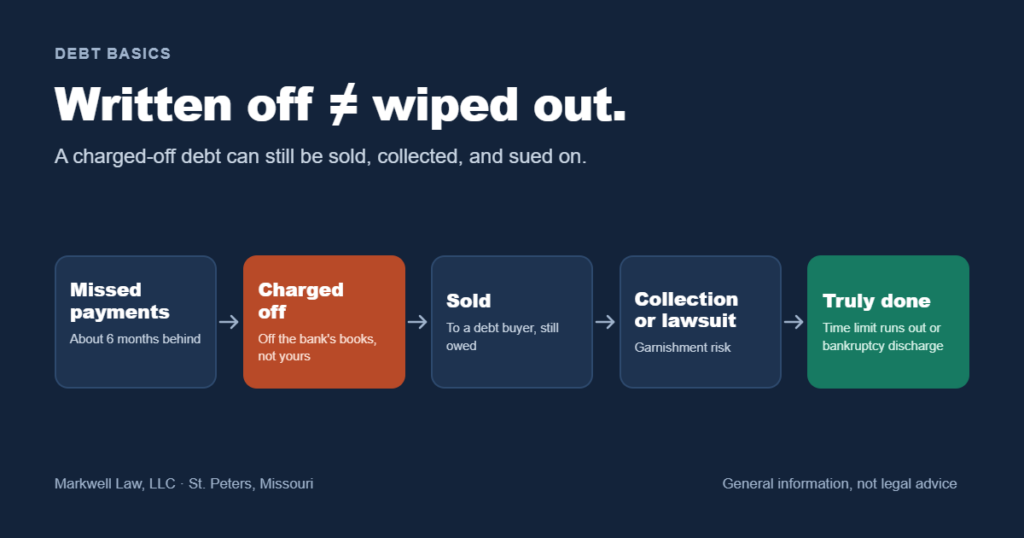
A write-off is an accounting move, not forgiveness. When you stop paying a credit card, the bank usually charges the debt off after about six months of missed payments. Banking regulators expect it. The bank moves your balance from “money we expect to collect” to “loss” on its books, and it may even get a tax break for it.
Notice who that helps. The bank. Not you.
What It Means on Your Credit Report
Short version: a charge-off is a serious black mark. It tells future lenders you stopped paying and the creditor took a loss, and it stays on your report for about seven and a half years from your first missed payment. Paying it turns it into a “paid charge-off,” which looks a little better, but it doesn’t disappear. The details (dates, duplicates, errors, and what to check) are in my post on charge offs on your credit report.
What It Means in Real Life
Here’s the part that surprises people: you still owe the money. Legally, a charge-off doesn’t cancel anything. The bank can keep trying to collect, hand the account to a collection agency, or sell it to a debt buyer for pennies on the dollar. That debt buyer then owns the right to collect the full balance.
Meet Karen. She’s hypothetical, as always. Karen stopped paying a $6,000 credit card in 2024 after her hours were cut. Six months later, the bank charged it off, and Karen figured that was the end of it. In 2026, she gets a letter from a company she’s never heard of, saying it now owns her account. A few months later, she’s served with a lawsuit in St. Louis County. If she ignores it, the debt buyer gets a default judgment and can garnish her wages or freeze her bank account. WTH?
Charged off? Sure. Dead? Not even close.
So When Is the Debt Actually Dead?
In Missouri, a creditor generally has five years to sue on credit card debt, counted from your last payment or default. Some creditors argue for ten years when there’s a written contract. (I dig into the details in my post on the statute of limitations for credit card debt in Missouri.) Once that deadline passes, the debt is “time-barred.” A collector can still ask you to pay, but it can’t sue you or threaten to sue.
But watch out for the trap. Meet Tom. Tom hasn’t paid on an old charged-off card since 2019. In 2026, a collector calls and says, “Just send $25 to show good faith.” Tom sends it. Congratulations, Tom. In Missouri, a payment like that can restart the clock, and now the collector may be able to sue him for the whole balance. Before you pay a dime on an old debt, talk to a lawyer.
And even a time-barred debt isn’t erased. It can stay on your credit report until the reporting period runs out, and it can be sold and resold along the way.
Do I List Write-Offs / Charge Offs in a Bankruptcy?
Yes, absolutely yes. If you are filing for bankruptcy protection, you should like all debt, write off / charge offs included. No exceptions.
What About Taxes?
If a creditor eventually cancels the debt, meaning it agrees you no longer owe it, you may get an IRS Form 1099-C, and canceled debt can count as taxable income. There are exceptions, including if you were insolvent at the time or the debt was discharged in bankruptcy. This is a good time to call your tax preparer.
The Only Sure Way to Kill It
Charged-off credit card debt is exactly the kind of debt a Chapter 7 bankruptcy wipes out. Once it’s discharged, nobody can collect it. Not the bank, not the debt buyer, not the debt buyer’s cousin. The discharge is permanent, the account should report a zero balance as “included in bankruptcy,” and debts discharged in bankruptcy aren’t taxable income.
The Bottom Line
“Written off” means the greedy blood-sucking scoundrels, um, the bank wrote it off its books. It didn’t write it off yours. Until the statute of limitations runs out or a bankruptcy discharge wipes it away, a charged-off debt can come back to bite you.
If you’ve got charged-off accounts, collection letters piling up, or a lawsuit with your name on it, call Markwell Law, LLC in St. Peters for a free consultation.
St. Peters, MO 63303
Phone: 636-486-1093
Fax: 636-634-3462